By Jeremy Bochniak / jtb175@txstate.edu
Organized youth basketball is where many young athletes begin their dream of playing in sports, with a hope to maybe, one day, become a professional athlete. Some even coach young players into becoming the best player they can be.
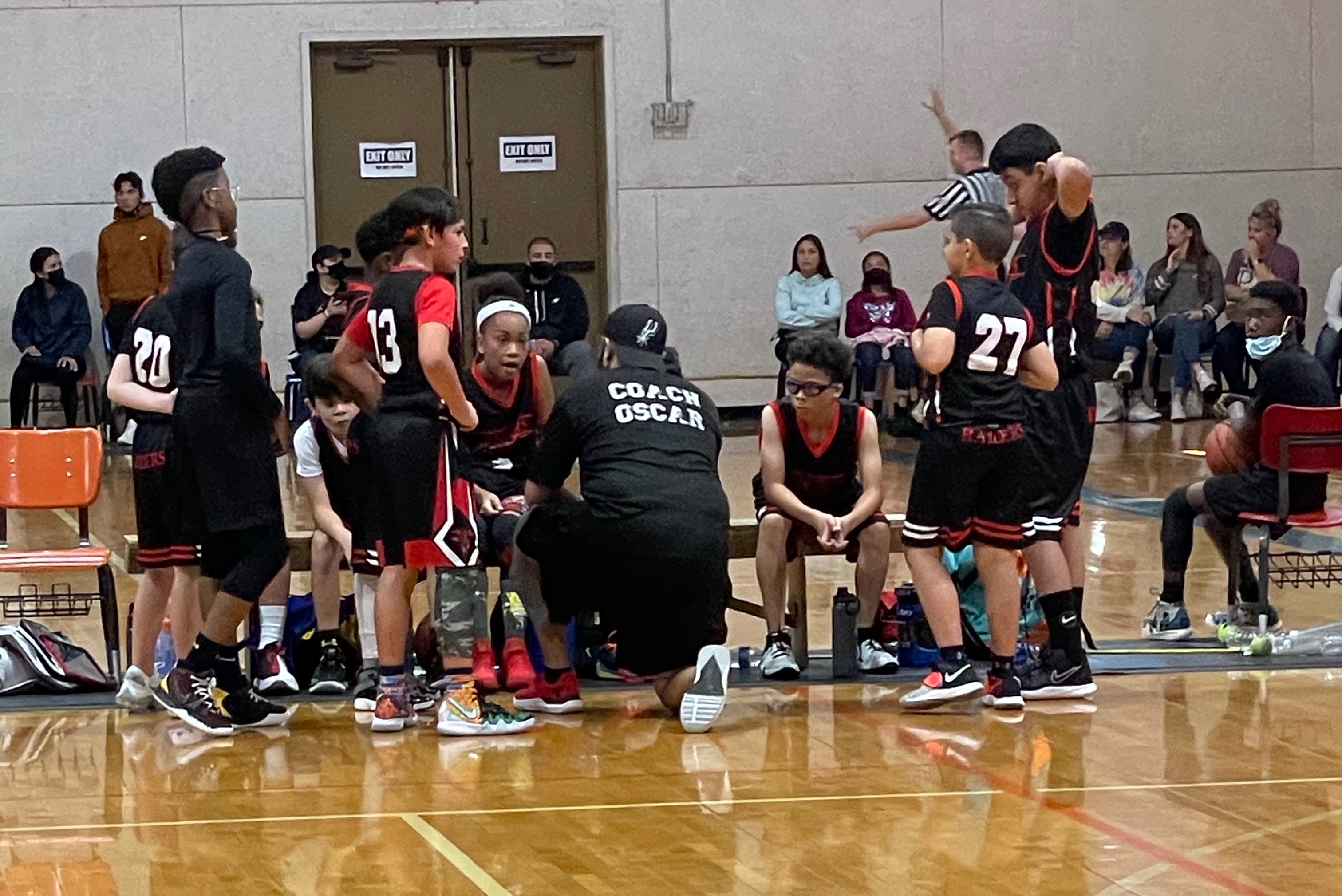
Oscar Elizondo has been coaching youth basketball since he was 13 years old. Starting with his local church team, he quickly transitioned to AAU, or Amateur Athletic Union, basketball. AAU basketball is primarily for higher skilled players, which includes scheduled practices, memorizing plays, and understanding all the rules relative to basketball, as compared to YMCA basketball or other organizations where everyone plays, no matter the skill level.
Elizondo has coached hundreds of players and has influenced coaches over time. Currently with the Next Level Raiders youth basketball organization in San Antonio, Texas, Elizondo has seen how drastic the AAU game has changed compared to when he first started coaching on the sidelines.
“It’s been awesome, I guess, the road to where I’m at now,” Elizondo said. “And just seeing the different styles of basketball, the evolution of youth basketball, and getting into it has been pretty awesome.”
“Players have changed. Certain things have shifted from 20 years ago to now and the biggest one to me is everybody has to be able to dribble, shoot, pass, rebound, and play defense.”

Cole Martinez, currently coaching Junior Varsity basketball at LEE high school in San Antonio, coincidentally started coaching at 13 years old and feels the rapid changes in the world of youth basketball.
“When I started, I played two bigs, I ran more plays, I taught more traditional basketball,” Martinez said. “Now, sometimes I have five guards on the floor, we get up and down, shoot lots of threes, it’s all about space and pace.”
Three-Point Shooting
In the 2000-01 NBA season, NBA teams averaged 13.7 three-point attempts per game, per basketball reference. One player (Antoine Walker) averaged more than seven three-point attempts per game. In the 2020-21 season, NBA teams are hoisting up 34.7 threes a game on average. An astounding 19 players are now averaging seven three-point attempts per game, with Stephen Curry leading the way at 12.1 per game.
How has that trickled down to youth basketball?
Freshman high school guard Liam Rangel, who Elizondo coaches, emphasized how big the three-point shot is to his repertoire.
“I think it’s a really big part of my game,” Rangel said. “Because now playing in this type of basketball, in this type of year, especially with the deep three-point shot coming in hand like you have to, you have to be able to hit that shot. I think it’s a big deal for me, and having the confidence to take that shot and not being afraid of hesitating in and doing something else with it.”
Elizondo adds that when looking at players to play for his team, shooting the ball is an absolute must in today’s basketball.
“The high school game, it’s the biggest part of it. I mean, we just had our tryouts for our high school kids on Sunday (at the time of the interview). We told them, if you can’t shoot the three-ball, why are you here? We can’t say it any other way. The value of the three-point has just skyrocketed since honestly, like 2015.”
Martinez echoes Elizondo’s sentiment.
“Kids love the three ball,” Martinez said. “…If kids get the foundation and strength to shoot it the right way (at a young age), then they become really hard to guard.”
Defense
With offenses scoring at a much more rapid pace, defense has been less of a force than in other previous generations. In 2000-01, NBA teams were allowing 94 points per game on average. Even in 2012-13, that number was slightly higher at 98 points per game. Now? Teams are averaging 111 points per game, the most since the 1971-72 season.
Elizondo believes this offense-first mentality is dominate through all levels of basketball.
“Nobody plays defense, nobody in the AAU world. It’s 40 minutes. And it’s crazy,” Elizondo said. “…And, you know, it’s, it’s part of the game. Yeah, the defense is very important. But it is non-existent. We do not play defense in this era of basketball at all anymore. And that’s from elementary and middle school, high school, right into the NBA.”
Martinez feels that newer rules cater to the offense.
“…Defenders cannot touch anyone,” Martinez said. “Points are what people want to see. Coaching now means teaching defensive rotations and closing out to guys on the three-point line.
Coaching
Elizondo and Martinez have been coaching for so long, they realize the adjustments to their coaching style and player development they’ve had to make to continue winning.
“Player development has become more basketball related than position related,” Martinez said. “Everyone that steps on the floor has to be able to dribble, pass, and shoot or they become a liability. “We spend a lot of time on skill development because ultimately, you need to (score) to win. Plays don’t work if your players can’t make plays.”
“If you let the players play, they’re going to create, they’re gonna make mistakes, nobody’s perfect,” Elizondo said. “But if you can allow them to play the game, and just learn the game, figure out what works best, who’s in foul trouble, who’s not a good defender, where can we attack and let the game take care of itself, your players are going to take over at the right time, they’re going to run the right sets because you’ve allowed them to do what they want to do.”
Another factor Elizondo has used is better communicating with his players off the floor, something he wasn’t able to do in the early 2000s.
“When I first started coaching, 20 years ago, I had to communicate with parents, as a 13-year-old, I had to communicate with parents about practice, about game times, schedule changes, you know, all that stuff that happens,” Elizondo said. “…now, I’m texting the players, the players are texting me.”
Elizondo also stresses how parents can make his life difficult as a coach trying to develop players.
“What parents, I think lose focus of, with your communication is the coaches telling them to do something as their child is on the court. If the parent doesn’t agree with them, they’re going to tell them no, don’t do that. No, do this. Now don’t worry about it do this, Hey, you got to do that. And it’s like now the kid, whether he’s a fifth-grader or an eighth-grader, senior in high school, now you’re putting that doubt in their head?”
Reporting/Social Media
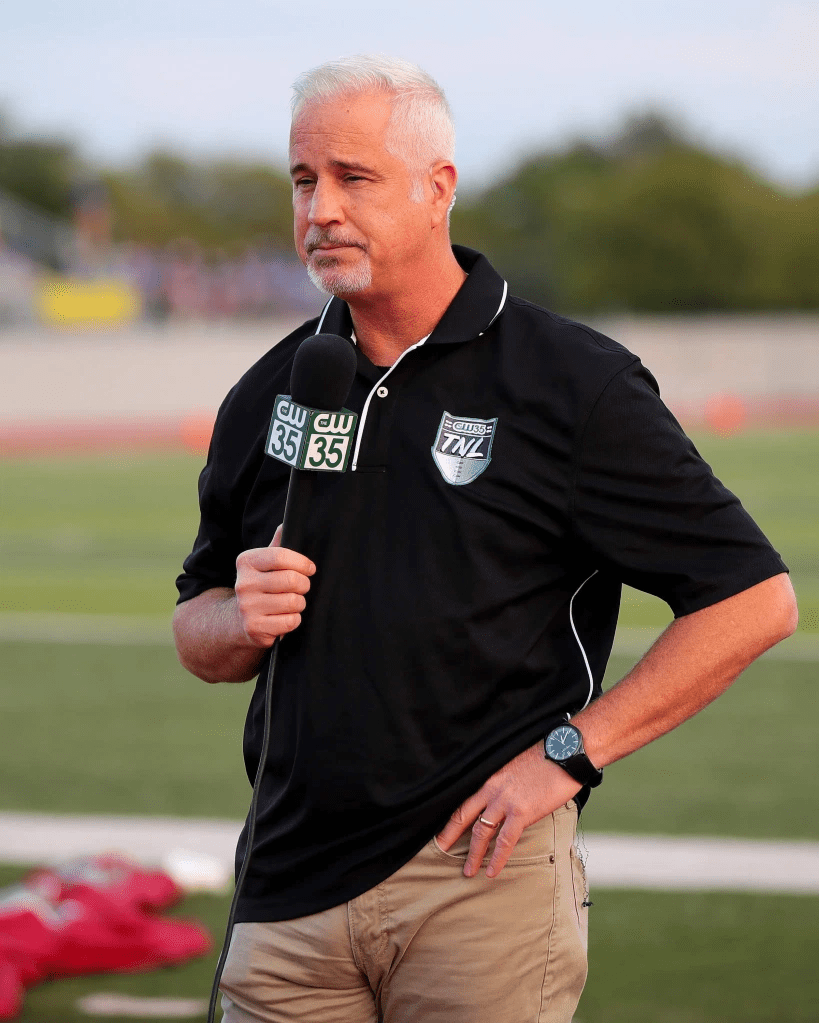
Chuck Miketinac has been a Fox Sports San Antonio Sports Anchor since 1999. Not only does he cover all professional sports, but also as many high school sports as he can. Miketenic compared the biggest differences in covering high school players compared to pro athletes.
“Overall, you just have to say, you have to find the humanity and everything that you’re doing in terms of storytelling,” Miketinac said. “So, you know, if a kid in high school is nervous when you’re talking to him on TV, you can have empathy with that, because he’s probably never done it before. And then the pro athletes have probably done it 1000 times, so he’s a little better at expressing himself.”
Miketinac also expressed how savvy high school athletes can be in front of the camera.
“I think it’s because you all grew up with video cameras in your face, cell phones in your face, it was a constant performance, even when you were a kid,” Miketinac said. “So in that regard, it’s better because kids are savvier in front of the camera. They’re not as shy in some cases. It’s a case-by-case kind of thing.”
In terms of on-court product, Elizondo has been concerned with being afraid of ending up on a highlight tape can affect effort from the players.
“The kid could have beat him off one dribble and scored a lay-up, but he’s up here ready to make the next highlight, the next Snapchat, the next viral video on Ballislife,” Elizondo said. “If you would have just gone to the rim you could have had a bucket, you could have set your teammate up for a bucket, but it’s now how can I get the next highlight, not playing the right way at times.”
Martinez believes kids are distracted by social media off the floor, limiting their own development as players.
“I am happy when they watch basketball,” Martinez said. “I think kids spend too much time on Tik-Tok, video games, and other things instead of watching basketball and becoming students of the game.”
Women’s Hoops

San Diego State University junior guard Sophia Ramos played AAU basketball starting in Elementary School, and she credits that experience with her getting a basketball scholarship.
“AAU was the best experience… I remember joining my first team in second grade and just realizing how different and competitive it was,” Ramos said. “Ultimately … it’s what helped me get to play in college.”
Ramos sees similarities and differences between the men’s and women’s games, with one glaring difference being shot selection and overall basketball fundamentals.
“I feel as if the men’s game relies too heavily on the three-point shot,” Ramos said. “Many are looking to pull the three in transition, or even take a tough three-pointer instead of making an extra pass to create better shots.”
“If you ever just sit and watch a women’s game, whether it be pro, college, or even AAU, anyone can see how much more discipline and fundamental the game is.”
Ramos explains that just because women may not be as athletically gifted as men, it doesn’t take away any of the excitement from the game and only adds to what makes their game great for any basketball fan.
“The way that some of the women play using their (basketball) IQ, skill-set, and athleticism just shows that the stereotype that women’s basketball is boring is just not true,” Ramos said. “Especially not at the rate the game is changing.”
The Future of Amateur Basketball
With position-less basketball a mainstay all across basketball, the future of basketball seems open to more possibilities than ever.
“It’s as clear, you have to have three-point shooters on your team,” Elizondo said. “Regardless of who your height was, you got to be able to knock down the three-pointer. So from the second and third grade up to high school. That has now impacted the game… just monumental levels that I never thought would happen.”
“Basketball is imperfect,” Martinez said. “What was crazy 20 years ago is normal today; who knows what this game will look like 20 years from now.”
 JB Sports Talk